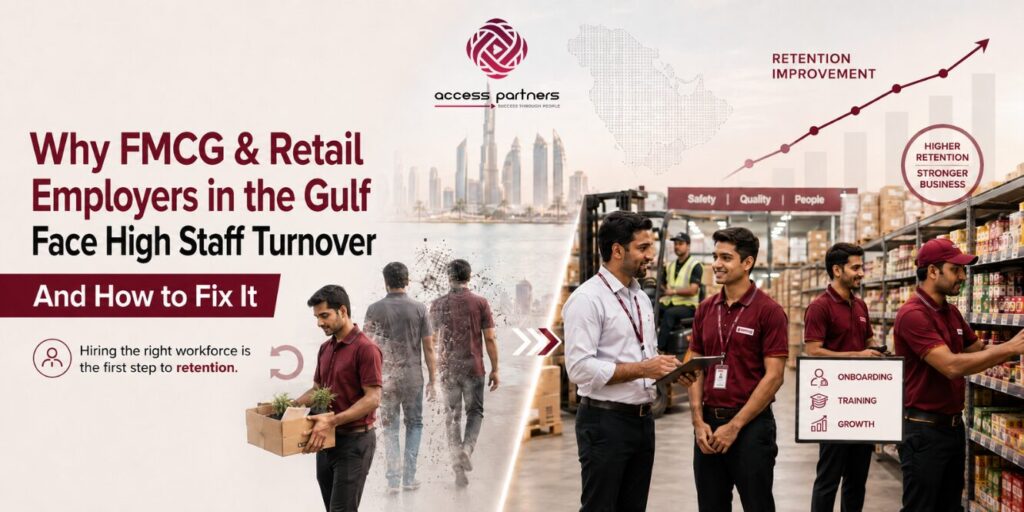
If you run an FMCG or retail business in the Gulf, you’ve probably felt it. You finally get a store, warehouse, or sales team fully staffed, and within a few months, you’re back to interviewing again. This isn’t bad luck. It’s a regional pattern, and the numbers back it up. Retailers across the GCC face turnover rates averaging 25 to 30 percent, well above the global retail average of around 15 to 20 percent.
That gap costs real money, slows growth, and wears down whoever is left holding the operation together. Here’s why it happens, and what actually fixes it.
The Real Cost of Losing Staff Again and Again
Before looking at causes, it helps to understand what turnover actually costs. When an employee leaves, replacing them typically costs between 50 and 150 percent of that person’s annual salary once you account for recruitment, training, lost productivity, and the slower service that comes with a half-trained team. For a mid-sized retailer running a hundred-person workforce, that adds up to a serious drag on profit every single year, money that should be going into growth instead of constant rehiring.
And this isn’t just about losing one person at a time. High turnover quietly damages everything around it: customer experience drops when staff are new and unsure, supervisors spend more time training than managing, and remaining employees start wondering if they should leave too. It becomes a cycle that feeds itself.
Why Turnover Is Higher in the Gulf Specifically
Expat-heavy workforce with limited roots. In countries like the UAE and Qatar, expatriates make up 70 to 90 percent of retail staff. Many come on fixed contracts, and without strong reasons to stay, a slightly better offer down the road or a contract that simply isn’t renewed becomes the natural exit point.
Pay that doesn’t match the sector’s growth. Retail in the Gulf is expanding fast, but frontline pay often hasn’t kept pace. Compensation gaps remain a major driver of turnover, since retail salaries frequently lag behind sectors like banking, government, or oil and gas, leaving workers willing to jump for even modest pay increases elsewhere.
Few visible career paths. A large share of retail operations in the region never built clear paths from store helper to supervisor to manager. When employees can’t picture what year three or year five looks like, they stop investing emotionally in the job and start looking elsewhere.
Nationalization pressure adds complexity, not less. Saudization and Emiratisation rules don’t cause turnover directly, but they add layers of compliance and recruitment timing that make workforce planning harder, especially when local hiring targets shift mid-year and companies scramble to rebalance teams.
Physically demanding, high-pressure roles. Long hours on the floor, peak-season pressure, and repetitive tasks wear people down faster in retail and warehouse jobs than in office-based roles, and burnout shows up quickly when there’s no support system around it.
What Actually Reduces Turnover
The good news is that none of these causes are unsolvable. Companies that have brought turnover down sharply, in some cases from 35 percent to around 18 percent within a year, tend to focus on a few specific things rather than trying to fix everything at once.
Build a real promotion pathway. When employees can see a structured route from entry-level roles into supervisory or leadership positions, with training programs that actually exist on paper and in practice, they stay longer simply because there’s something to stay for.
Pay attention to onboarding, not just hiring. A worker who feels lost in their first month is far more likely to quit in month three. Clear training, a defined first ninety days, and a manager who actually checks in make a measurable difference in how long someone stays.
Hire for fit, not just for an empty seat. Rushed hiring to fill a gap quickly often backfires, since mismatched candidates leave faster than they were hired. Taking the extra time to verify skills and genuine interest in the role upfront saves far more time later.
Offer flexibility where you can. Things like predictable scheduling, reasonable shift planning, and basic respect for personal time go a long way in physically demanding retail and warehouse roles, even when major pay increases aren’t immediately possible.
Work with a recruitment partner who screens for retention, not just availability. This is often the missing piece. Many turnover problems start at the hiring stage itself, when candidates are placed quickly without proper screening for whether they’re actually suited to long-term retail or warehouse work.
How Access Partners Helps Gulf Employers Break the Cycle
Access Partners works with FMCG and retail employers across Saudi Arabia, the UAE, and the wider Gulf to address turnover at its root, starting with the hiring process itself. Instead of simply filling open positions as fast as possible, the focus is on sourcing candidates from India who are genuinely suited to the role, properly screened for relevant experience, and clear on what the job and contract actually involve before they ever accept an offer.
This matters because a large share of early turnover comes from mismatched expectations, candidates who didn’t fully understand the role, the hours, or the environment they were stepping into. Access Partners reduces that risk through structured interviews, skill verification, and transparent documentation, so employers receive workers who are more likely to stay, perform well, and grow into supervisory roles over time.
For employers managing ongoing staffing needs across multiple stores or warehouses, Access Partners also supports workforce planning that balances local hiring requirements with reliable overseas talent, helping reduce the constant churn that eats into both budgets and operational stability.
Bringing It Together
Turnover in Gulf FMCG and retail isn’t going to disappear overnight, but it also isn’t something employers have to simply accept as the cost of doing business in the region. The companies that get ahead of it treat hiring as the first and most important retention tool, not an afterthought.
Struggling with constant staff turnover in your FMCG or retail business? Talk to Access Partners about building a workforce that actually stays.