Here’s the problem most Gulf employers run into: you win the project, you need 200 workers on site in six weeks, and you start hiring after the contract is signed. By the time medicals, certificates, and visas clear, you’re already behind schedule — and paying penalty costs for it.
A worker pipeline flips this around. Instead of hiring one project at a time, you keep a steady, pre-checked pool of workers ready to move the moment you need them. This article breaks down what that actually looks like, and why it saves Gulf employers real time and money.
Why “Just-in-Time” Hiring Keeps Failing
Most manpower delays don’t come from a shortage of workers. They come from paperwork and timing that nobody planned for in advance.
Take the GAMCA medical certificate. It’s valid for only 60 days, and there’s no extension. If a worker’s medical clears but the visa or travel gets delayed past 60 days, you start the entire medical process over. Multiply that across 100 or 200 workers, and a small scheduling slip turns into weeks of lost time.
Safety certification works the same way. A BOSIET certificate that lapses means a full three-day retake — not a quick refresher. For oil, gas, and construction sites where safety training is mandatory before site access, this alone can push back a mobilization date by a week or more.
Then there’s eMigrate registration, which every employer needs to complete before Indian workers can be legally deployed. Employers who don’t know this exists often find out only when their manpower agency mentions it — after the project timeline is already set.
None of these delays are because good workers aren’t available. They happen because hiring starts too late to absorb normal processing time.
What a Ready Worker Pipeline Actually Means
A pipeline isn’t just a bigger database of resumes. It means:
- Workers are pre-screened before you need them — skill-tested, background-checked, and matched to real site roles like steel fixers, HSE officers, or shuttering carpenters, not generic labor categories.
- Certificates are tracked and current — GAMCA, , ITI/NCVT trade certificates are monitored so they don’t expire mid-process. Note: ITI/NCVT trade certificates don’t expire, so once verified, they stay valid for future postings too.
- A backup bench exists — if a worker drops out or fails final medical, a replacement is already in the pool, not weeks away from being sourced.
- Compliance is handled upfront — eMigrate registration, Nitaqat category checks for Saudi employers, and visa documentation are prepared before the urgent stage, not during it.
This is the difference between hiring reactively and hiring on a supply chain. One creates delays. The other prevents them.
How Access Partners Builds This for Gulf Employers
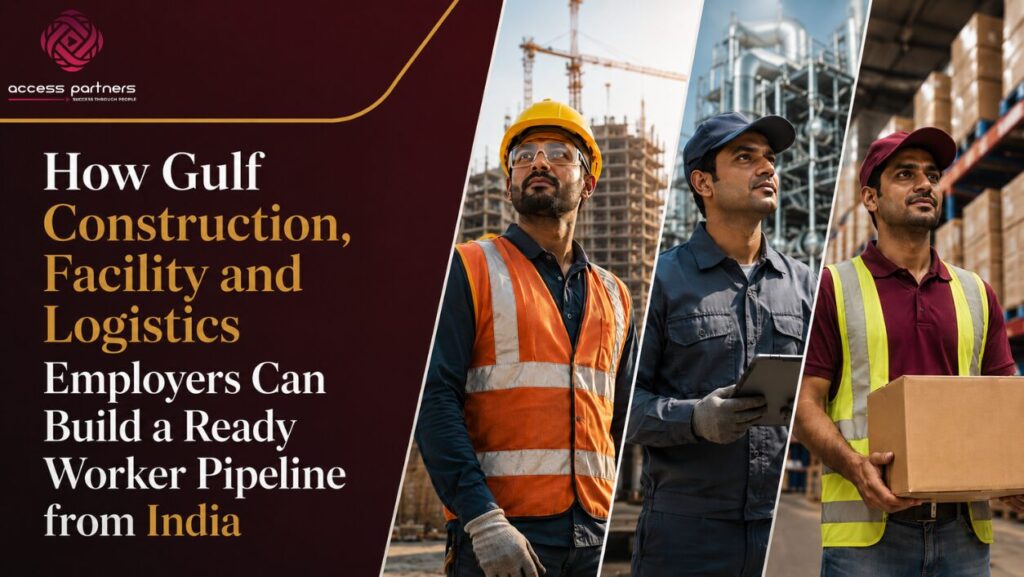
Access Partners works across six sectors — Construction, Oil and Gas, O&M, FMCG, Hospitality, and Logistics — and the pipeline model is the same across all of them: source early, verify properly, and keep a bench ready.
For construction and FM clients specifically, this means maintaining pools of trade-tested workers — from HSE officers to skilled tradesmen — who already have current medicals and safety certificates on file. When a Saudi or UAE employer needs 50 or 500 workers for a new project, the sourcing and screening work is already done. What’s left is matching, final documentation, and mobilization — which is the part that should take days, not months.
This also protects employers from a hidden cost: replacement hiring. When a worker mobilized in a rush turns out to be a poor fit, the project absorbs the cost of downtime, re-hiring, and lost productivity twice. A pipeline built on proper screening the first time avoids that entirely.
Common Questions Gulf Employers Ask
How long does it take to mobilize construction workers from India to the Gulf?
With a ready pipeline already in place, mobilization can happen in 3–5weeks. Without one, starting from scratch often takes 8–12 weeks once medicals, certificates, and visas are factored in.
Why do Gulf construction projects face worker mobilization delays?
Most delays trace back to GAMCA certificate timing, BOSIET lapses, or late eMigrate registration — not a lack of available workers.
How do I choose a manpower recruitment agency for Gulf construction?
Look for an MEA/Recruiting Agent licensed agency with a track record in your specific sector, and one that maintains a ready worker pool rather than sourcing only after you sign a contract.
Build Your Pipeline Before You Need It
If your last project got delayed waiting on workers, the fix isn’t hiring faster next time — it’s hiring earlier, before the deadline pressure starts. That’s what a real pipeline does: it moves the hard work upfront so mobilization becomes the easy part.
Access Partners already maintains verified, site-ready worker pools across construction, facility management, and logistics for employers across Saudi Arabia, UAE, Qatar, Oman, Kuwait, and Bahrain. If your next project needs workers on the ground fast, get in touch with Access Partners today to start building your pipeline before the deadline pressure hits.