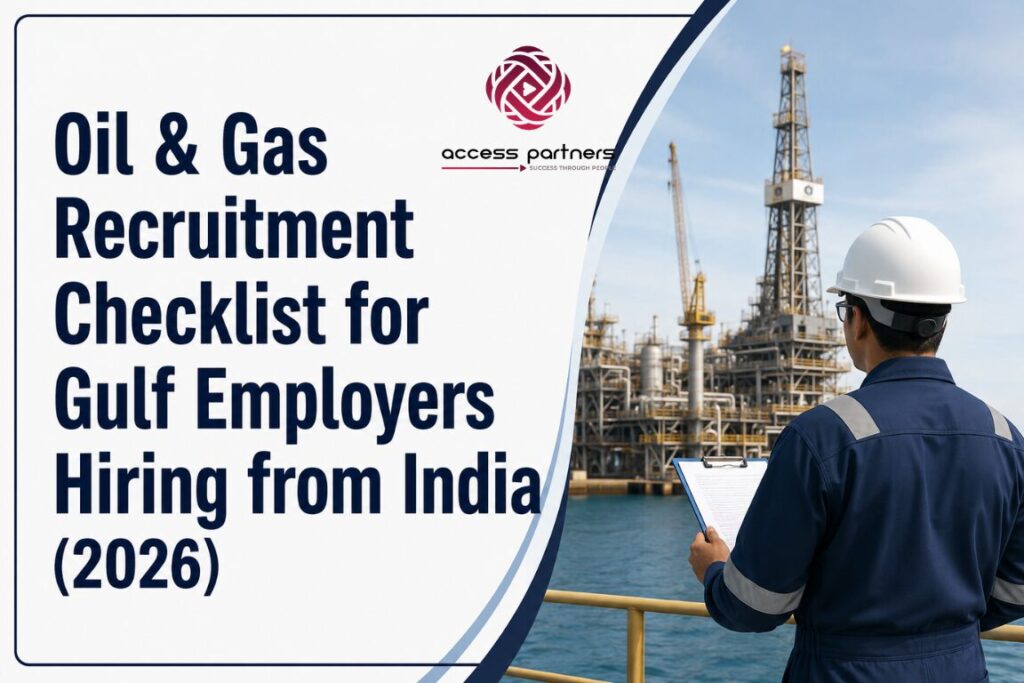
Hiring manpower from India for a Gulf oil and gas project involves more moving parts than most employers expect: certifications, government compliance, medical clearances, visas, and on-site onboarding, all before a single worker picks up a tool. Miss one step and your mobilization date slips.
This checklist walks through every stage, from defining the job to getting workers productive on site, so nothing falls through the cracks.
- Step 1: Define the Job Clearly
- Step 2: Certification Checklist by Role
- Step 3: Compliance Checklist (India Side)
- Step 4: Documentation and Medical Checklist
- Step 5: Payroll and On-Site Compliance Checklist
- Step 6: Post-Deployment Checklist
- Why This Checklist Matters More Than Ever
- How Access Partners Handles This For You
- Ready to Build Your Crew the Right Way?
Step 1: Define the Job Clearly
Before you contact any agency, get specific. Vague job orders are the number one reason wrong candidates show up.
- Onshore or offshore role (offshore hires need different certifications and rotation planning)
- Rotation schedule (commonly 28/28 or 14/14 for offshore postings)
- Exact trade and skill level (a 6G-certified pipeline welder is not the same hire as a general structural welder)
- Your main contractor’s vendor or ICV compliance standard, if one applies
- Contractor prequalification requirements, such as alignment with ADNOC’s HSE Management System or similar operator standards
Step 2: Certification Checklist by Role
Different roles need different paperwork. Here’s a quick reference:
- Welders: CSWIP or ASME-based certification, tested on the exact position (like 6G) your project requires
- Pipe fitters and riggers: Trade test certificates plus basic rigging/lifting safety training
- HSE officers and safety supervisors: NEBOSH IGC as a baseline
- Offshore-bound workers: BOSIET or T-BOSIET (offshore safety induction), plus a valid offshore medical certificate
- Technicians in inspection or QAQC roles: Relevant API certification
Never take a certificate at face value. Ask your recruitment partner to confirm it with an actual practical trade test, not just a paper check.
Step 3: Compliance Checklist (India Side)
This is the part employers skip most often, and it’s the part that causes the most delays later.
- Confirm the agency holds an active Recruiting Agent (RA) license from India’s Ministry of External Affairs
- Verify the license directly on the eMigrate government portal, don’t just take their word for it
- Register your company as a Foreign Employer on eMigrate for ECR (Emigration Check Required) category workers
- Make sure worker contracts are registered on eMigrate before deployment
- Confirm workers are covered under the Pravasi Bharatiya Bima Yojana insurance scheme
Skipping this step doesn’t just risk fraud. It risks your workers being denied emigration clearance at the last minute, right when you need them on site.
Step 4: Documentation and Medical Checklist
- Passport validity and correct ECR/ECNR category
- Medical fitness certificate from an approved medical center
- Offshore medical certificate (if the role requires offshore travel)
- Employment visa processed and matched to the correct job title and category
- Signed employment contract in the worker’s language, registered on eMigrate
Step 5: Payroll and On-Site Compliance Checklist
Once workers land, your compliance responsibilities don’t end, they shift.
- Enroll workers in your host country’s Wage Protection System (WPS) to ensure salaries are paid on time and on record
- Complete site-specific HSE induction before any worker is issued a Permit to Work
- Brief supervisors on Permit to Work (PTW) requirements and confirm understanding, not just attendance
- Set up random compliance audits for the first few weeks on site, this is when most gaps show up
Step 6: Post-Deployment Checklist
Recruitment doesn’t end at arrival. Track these to catch problems early:
- 30-day check-in on worker performance and site fit
- Retention tracking against your project timeline
- Renewal or end-of-service planning well before contract expiry, not after
- A clear channel back to your recruitment partner if a replacement is needed
Why This Checklist Matters More Than Ever
Gulf oil and gas projects are running on tighter timelines and larger crews than in past years, with major operators pushing ahead on expansion, turnaround, and carbon-capture work across the region. A single missed certification or a skipped eMigrate step can hold up an entire crew’s mobilization by weeks. Employers who build this checklist into their hiring process from day one avoid the scramble that catches everyone else off guard.
How Access Partners Handles This For You
We built our process around this exact checklist, so you don’t have to manage it line by line yourself.
Every candidate we put forward is trade-tested in-house before you see a resume. We handle RA license compliance, eMigrate registration, and contract documentation as standard practice, not an add-on. Medical clearances and insurance are confirmed before deployment, not chased afterward. And once your crew is on site, we stay involved through onboarding and beyond, so if something needs adjusting, you’re not left managing it alone.
If you’d like a copy of this checklist as a printable reference for your team, just ask, we’re happy to send one over.
Ready to Build Your Crew the Right Way?
If you’re mobilizing manpower for a Gulf oil and gas project, run your hiring plan against this checklist, or let Access Partners manage it for you. Reach out with your job requirement and we’ll walk you through exactly where your project stands.