Quick Answer: Screening these two roles takes different tests, not one shared checklist. For a forklift operator, an Indian training certificate is usually a private certificate, not a government license. Its rigor varies widely between institutes. Confirm which body issued it and whether a real practical test was included. Then plan for local certification after arrival. Neither Saudi Arabia nor the UAE accepts a foreign forklift certificate as a substitute. For warehouse staff, skip the resume and test the actual skill: picking accuracy, inventory system familiarity, and safe handling under time pressure. Some employers screen both roles the same way, using only interviews and paper certificates. Those are the employers who end up mobilizing workers who still need to be certified or retrained on-site.
A candidate lists “certified forklift operator” on their CV, and an employer assumes that settles the matter. Then the worker arrives in the Gulf and cannot legally touch a forklift until local certification is complete. A separate warehouse hire looks confident in an interview, then struggles with real order volume in the first week. Both problems come from the same root cause: treating a paper credential as proof of readiness. Here is how to screen each role properly, before mobilization, not after.
- Why These Two Roles Need Different Screening
- What an Indian Forklift Certificate Actually Tells You
- Local Certification Still Applies After Arrival
- Screening Warehouse Staff: Test the Skill, Not the Resume
- A Few Warning Signs Worth Checking Twice
- Building One Screening Process for Both Roles
- Why Employers Choose Access Partners
Why These Two Roles Need Different Screening
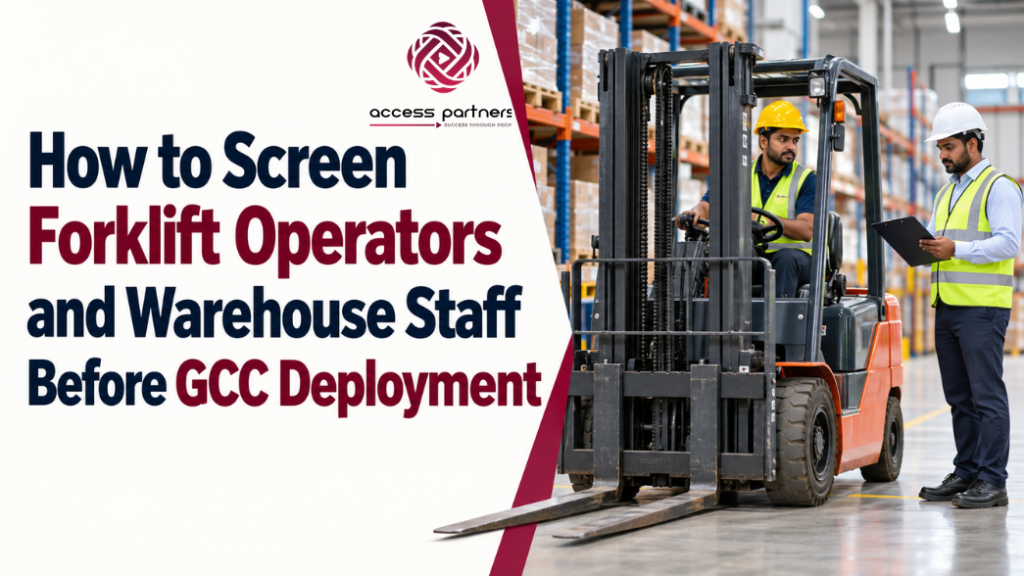
Forklift operation is a certified, equipment-specific skill with legal requirements attached to it. Warehouse work covers a broader mix of physical stamina, accuracy, and familiarity with inventory systems. It usually has no single certifying body at all. Treating both roles with the same generic “experience check” misses what actually matters for each one. A forklift operator needs their certificate verified for real content and their equipment type confirmed. A warehouse worker needs their actual picking and handling skill tested instead. There is rarely a credential to check in the first place.
What an Indian Forklift Certificate Actually Tells You
Most Indian forklift certificates come from private training institutes, not a government licensing authority. One widely available course runs three months online. It finishes with a 30-question multiple-choice exam that requires only 40% to pass (IISDT, Certificate in Forklift Operator). Other institutes run longer, more rigorous programs with real practical driving assessments. The certificate alone does not tell you which kind of training a candidate actually received. Before trusting it, confirm the issuing institute. Ask whether a hands-on practical test was part of the course, and check what forklift type the training actually covered. A certificate naming a counterbalance truck does not verify skill on a reach truck, and the two operate quite differently.
Local Certification Still Applies After Arrival
This is the step employers miss most often. A Saudi forklift license is legally valid only inside Saudi Arabia, no matter what certificate a worker already holds. It requires a minimum age of 21 and a medical clearance. Workers must also pass an approved theory and practical test through local channels (Saudi Driving License, Forklift Driving License in Saudi Arabia). The UAE runs its own separate scheme entirely. Velosi Certification Services runs this scheme under ISO/IEC 17024 accreditation. It requires a written exam scored above 80%. A separate practical exam follows it, scored above 75%. It is tested on the actual forklift model the worker will use (Applus+, Certification Scheme for Forklift Operator, UAE). Neither country’s process makes an exception for a foreign certificate. Budget the time and cost of this local certification into your mobilization plan from day one. Treat it the same way you would a heavy vehicle driver’s local licensing.
Screening Warehouse Staff: Test the Skill, Not the Resume
A warehouse role rarely comes with a formal certificate to check. This makes interviews and reference checks less reliable on their own. A proper pre-employment skills test measures order-picking accuracy and correct label reading. It also checks safe handling of goods under realistic time pressure (TestGorilla, Warehouse Picker Test). Run this kind of test early, before a full interview round. This filters out weaker candidates before you invest more time. Ask candidates to describe a real inventory system they have used, not just claim general “warehouse experience.” A candidate who cannot explain how they logged stock movements is worth a second look. The same goes for someone who cannot describe how they handled a picking error at a past job. It is the same principle as a driver who cannot describe a real incident on the road.
A Few Warning Signs Worth Checking Twice
Some signals are worth a second look before a candidate reaches your shortlist. A forklift certificate with no institute name, no course length, and no practical component listed is a weak signal on its own. A candidate who cannot name the forklift type they trained on is another. For warehouse roles, watch for vague answers about which inventory system they used. An inability to describe a real stock error, and how it was fixed, deserves a follow-up question rather than a pass. None of these signs alone should end a candidate’s chances. Together, they tell you where to slow down and verify more before mobilization.
Building One Screening Process for Both Roles
A combined mobilization plan still treats these two roles differently at each stage. For forklift operators, verify the Indian certificate’s real content first. Then build in the full local certification window for Saudi Arabia or the UAE, before committing an equipment-operating start date. For warehouse staff, run a practical skills test early. Confirm real system experience through direct, specific questions rather than a general experience claim. Neither role should reach your final shortlist on the strength of a document or a confident interview alone.
Why Employers Choose Access Partners
Access Partners has sourced skilled and semi-skilled workers for Gulf employers since 2005. We hold a valid MEA/RA license as an overseas manpower consultancy. For forklift roles, we check the issuing institute and training content behind every certificate. We are upfront about the local certification step that still applies after arrival, so it never comes as a surprise. For warehouse roles, we test real picking and handling skill before a candidate ever reaches your shortlist, not just their claimed experience. We manage GAMCA, eMigrate, and visa processing end to end. With offices in both India and Saudi Arabia, a documentation or scheduling question gets resolved fast, without losing days to distance.
Are you deploying forklift operators or warehouse staff to the Gulf? Talk to Access Partners about a screening process that catches gaps before mobilization, not after.