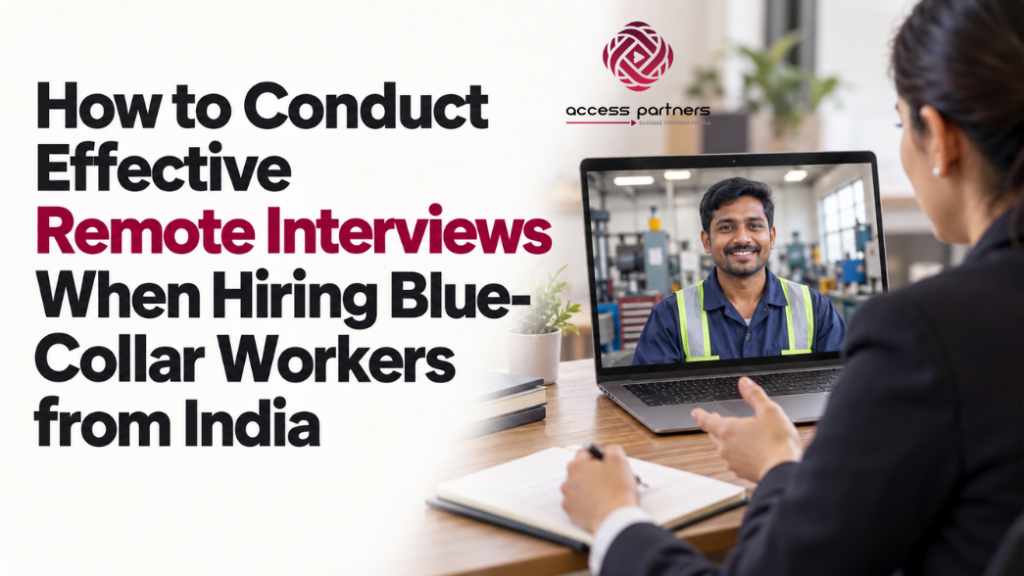
Quick Answer: Gulf employers run effective remote interviews by fixing three things first. Pick a channel the candidate can actually use well. A WhatsApp video call often works better than a formal platform for blue-collar hiring in this region. Schedule at a reasonable hour in the candidate’s time zone, and provide a translator when needed. Then verify the trade skill directly, not just through talk. Ask the candidate to show original documents on camera. Walk through real project scenarios, and confirm everything with a proper trade test before you commit. A remote interview that skips this last step is really just a conversation, not a hiring decision.
A good remote interview can feel exactly like a good in-person one. A bad one leaves an employer with a worker who talks well but cannot do the job. This gap matters more in blue-collar hiring than almost anywhere else. You are not just checking if someone communicates clearly. You are trying to confirm, through a screen, that they can weld a joint. Can they operate a machine, or wire a panel correctly? Here is how to actually do that well.
Why Remote Interviews Work Differently for Blue-Collar Roles
An office hire can often be judged by how they explain their work. A blue-collar hire has to be judged by what they can actually do. This is the core challenge of hiring remotely from India for a Gulf job site. You cannot hand a candidate a wrench over video. What you can do is ask sharper questions and watch more carefully. Lean harder on document checks and a real trade test after the interview ends. Treating a remote interview as the finish line, instead of one step in a larger screening process, is where employers get into trouble.
Choose the Right Channel, Not Just Any Channel
Formal video platforms like Zoom, Microsoft Teams, and Google Meet all work fine. They suit a scheduled, professional round well (Marfa Overseas, How to Use Video Interviewing for International Candidates). But do not assume a formal platform is always best for this region. WhatsApp has over 95% penetration among working-age adults across the GCC. It is the dominant first-contact channel in Gulf recruiting (Huntlo, Gulf Hiring Trends 2026). Many candidates in India are simply more comfortable on a WhatsApp video call than a formal meeting link. A live call works best for real-time back and forth. A recorded round can help when time zones make live scheduling difficult (Marfa Overseas, Video Interviewing for International Candidates). Use both stages if your headcount is large.
Fix the Time Zone and the Language Gap
Scheduling at a bad hour sends a bad signal before the interview even starts. Double-check the time conversion. Never schedule a candidate for the middle of their night (Marfa Overseas, Video Interviewing for International Candidates). Use a calendar invite that adjusts automatically across time zones, so nobody miscounts the hours. Language matters just as much. Speak clearly, and avoid complicated terms the candidate may not know in English. For blue-collar roles, many recruitment agencies provide a translator during the interview itself (Marfa Overseas, Video Interviewing for International Candidates). This is not a sign of a weak candidate. It is a sign of a properly run interview.
How to Verify a Skill You Cannot Touch
This is the part most employers get wrong. A candidate can describe a weld or a repair perfectly and still not be able to perform it. Ask scenario-based questions about specific past projects, not general questions about experience. Have the candidate explain exactly how they solved a real problem on a real job. Ask them to hold up original certificates and identity documents on camera during the call. Follow up with scanned copies afterward, for proper verification (Marfa Overseas, Video Interviewing for International Candidates). None of this replaces a hands-on trade test. It simply narrows your shortlist before you invest in one. Treat the remote interview and the trade test as two separate steps, not one combined check.
Red Flags Worth Watching For
A few signals are worth taking seriously during the call. A candidate who cannot describe a specific past project, only general duties, may be overstating their experience. Reluctance to show a document on camera is worth a direct follow-up question. Vague answers about tools, materials, or brand names specific to their trade are a warning sign too. None of these alone means reject the candidate. Together, they mean slow down and verify more before you approve mobilization.
Where This Fits in the Bigger Hiring Process
A remote interview is one stage in a longer chain, not a replacement for it. Work only with a licensed Recruiting Agent holding a valid MEA/RA license. Only a licensed agency can legally source and deploy workers for overseas jobs. Follow the interview with an actual trade test on the real skill, not a repeat of interview questions. GAMCA medical clearance and eMigrate processing for workers with an ECR passport still apply, regardless of how the interview went. Skipping straight from a good interview to a job offer skips those steps. That is exactly how avoidable hiring mistakes happen.
Why Employers Choose Access Partners
Access Partners has sourced skilled and semi-skilled workers for Gulf employers since 2005. We hold a valid MEA/RA license as an overseas manpower consultancy. We run structured remote interviews on the channel that actually works for each candidate, backed by a translator when needed. We do not treat a good interview as proof of skill on its own. Every shortlisted candidate still goes through a proper trade test and document verification before reaching your final approval. We manage GAMCA, eMigrate, and visa processing end to end. With offices in both India and Saudi Arabia, we can resolve a documentation question fast, without losing days to distance.
If you are planning your next round of remote hiring from India, talk to Access Partners about your requirement.