Saudi Arabia’s ports are moving more cargo than they ever have. The workforce needed to run that cargo through warehouses, customs desks, and delivery routes is not growing at the same speed. That gap is now the single biggest hiring risk facing Gulf logistics, freight, and supply chain employers this year.
This is not a prediction. It is already showing up in hiring timelines across Jeddah, Dammam, and the Eastern Province.
The Data Behind the Demand
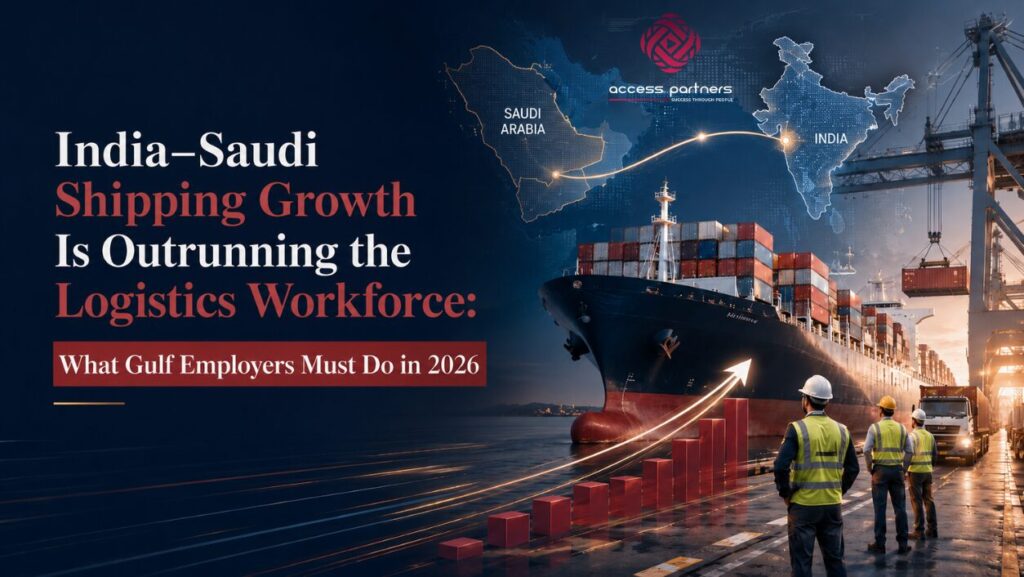
Trade numbers tell the real story here. The India-Saudi trade corridor is growing at 15.66% a year, and hit $42.7 billion in 2024. That is not a slow, steady climb. It is a fast-moving trend, and shipping infrastructure is racing to keep up with it.
In June 2026, Mawani, Saudi Arabia’s Ports Authority, added a new route through Jeddah Islamic Port connecting directly to Mundra Port in India and onward to the Port of Djibouti. The service can carry up to 2,144 shipping containers at a time, and it is one of several India-Gulf routes launched in the past 24 months.
Every one of these routes means more containers landing on Saudi soil. Every container needs someone to unload it, inspect it, store it, and move it forward. Ports do not run themselves. People do.
Why the Workforce Can’t Keep Pace
Saudi Arabia’s logistics sector is expanding faster than any hiring pipeline can naturally fill. The number of logistics facilities in the Kingdom has grown 267% since 2021, with the fastest growth happening in the Eastern Province. New warehouses, cold storage units, and industrial logistics zones are opening at a rate that outstrips local training programs.
Saudization aims to push more Saudi nationals into logistics roles, but the sector still depends heavily on expatriate labor, and matching skill supply with actual demand remains difficult. This is not a criticism of the policy. It is simply a timing problem. Building a skilled national workforce takes years. Port expansion is happening in months.
The roles driving this shortage span drivers, warehouse operators, customs specialists, freight forwarders, and supply chain managers. These are experienced positions. You cannot train someone for warehouse management or customs documentation overnight, especially while shipping volumes keep climbing every quarter.
The Roles Employers Struggle to Fill Right Now
Ask any operations manager at a Gulf port or distribution center what keeps them up at night, and the list looks the same almost everywhere:
- Warehouse operators trained on modern inventory systems
- Forklift and heavy equipment operators
- Freight forwarders who can manage customs paperwork without delays
- Supply chain coordinators who can plan around shipping disruptions
- Drivers with GCC-standard licensing and route experience
There is also a retention angle most employers overlook. Logistics professionals in this market are not just chasing a paycheck. They are looking for a career path, moving from warehouse work into inventory, then planning, then supply chain leadership. Employers who hire with that path in mind get lower turnover and stronger long-term teams.
Why Indian Talent Fits This Exact Moment
India runs some of the busiest ports in the world. Workers trained at Mundra, Nhava Sheva, and other major Indian ports already understand high-volume container handling, warehouse management systems, and freight documentation. Add strong English proficiency and ITI-level technical training, and you get a workforce that adapts to a Saudi warehouse floor with almost no ramp-up time.
The new shipping corridor between Mundra and Jeddah is not just a trade route. It is a signal that the workforce relationship between the two countries is deepening at the same pace as the cargo relationship.
Where Hiring Timelines Usually Break Down
Most delays are not about finding workers. They are about paperwork. eMigrate registration has to be filed correctly before recruitment starts. GAMCA medical certificates are valid for only 60 days, with no extension once that window closes. One missed step, and an employer loses weeks waiting to remobilize a candidate who was ready to work from day one.
How Access Partners Removes That Friction
Access Partners is an India-based overseas manpower recruitment consultancy serving Gulf employers across Construction, Oil and Gas, FMCG, Hospitality, and Logistics, with operations spanning Saudi Arabia, the UAE, Qatar, Oman, Kuwait, and Bahrain. We track shipping and trade shifts like this one closely, because they tell us exactly where workforce demand is heading next.
We keep a ready pipeline of pre-screened logistics workers, from warehouse staff to freight and supply chain professionals, and we manage the medical, visa, and mobilization steps so your hires arrive at site ready to work, not stuck in a documentation backlog.
If the India-Saudi shipping boom is already stretching your logistics team, now is the time to build your hiring pipeline, before demand outpaces your capacity.
Talk to Access Partners about your logistics staffing needs for Saudi Arabia and the wider Gulf region.