Quick Answer: Gulf employers should not choose between CV screening and trade testing. They need both. CV screening helps shortlist workers based on experience, job history and basic qualifications. A trade test proves whether the worker can actually perform the job before deployment. For skilled blue-collar roles such as welders, electricians, HVAC technicians, plumbers, riggers, heavy drivers and equipment operators, relying only on a CV can lead to wrong hiring, site delays and replacement costs.
- A Perfect CV Does Not Always Mean a Skilled Worker
- What CV Screening Actually Tells Employers
- What a Trade Test Actually Proves
- CV Screening vs Trade Test: What Is the Difference?
- Where CV Screening Alone Falls Short
- Why Trade Testing Matters More in Gulf Manpower Hiring
- The Real Cost of Skipping the Trade Test
- The Right Hiring Process for Blue-Collar Workers
- Which Blue-Collar Roles Need Trade Testing?
- What Gulf Employers Should Ask Before Approving Candidates
- How Access Partners Helps Gulf Employers Hire Better Blue-Collar Workers
- Final Answer: Use CV Screening and Trade Testing Together
- FAQs
- Is CV screening enough for blue-collar hiring?
- What is a trade test in manpower recruitment?
- Which workers should be trade tested before Gulf deployment?
- Does a trade test delay the hiring process?
- Why do Gulf employers need trade testing for workers from India?
- Does Access Partners manage trade testing and screening?
- Which countries does Access Partners recruit for?
A Perfect CV Does Not Always Mean a Skilled Worker
The CV looks strong.
Ten years of welding experience. Previous Gulf work history. Clean formatting. Good references. On paper, the candidate seems ready.
Then he reaches the site in Riyadh, Dubai or Abu Dhabi, and the weld does not pass inspection. The supervisor has to recheck the work. The crew loses time. The project slows down.
The problem was not visible in the CV.
This is one of the biggest risks in blue-collar manpower recruitment. A CV can show what a worker has done in the past, but it cannot always prove how well he can perform today.
That is why Gulf employers need a hiring process that uses both CV screening and practical trade testing.
What CV Screening Actually Tells Employers
CV screening is the first filter in the recruitment process. It helps employers check whether a candidate appears suitable for the role before moving him to the next stage.
A proper CV review can help confirm:
- Previous job titles and trade experience
- Years of work experience
- Past employers or project exposure
- Country experience, including Gulf experience
- Basic qualifications or certificates
- Role-specific background
- Employment gaps or unclear work history
CV screening is useful because it saves time. When an employer receives a large number of profiles, the CV helps narrow the pool to candidates who appear relevant.
But CV screening has a limit.
Many blue-collar workers learn through practical site experience, not formal education. Their resumes may not explain their actual skill level in detail. Some CVs may also exaggerate responsibilities, job titles or years of experience.
A CV can tell you a worker has experience. It cannot prove he can perform the task safely and correctly.
What a Trade Test Actually Proves
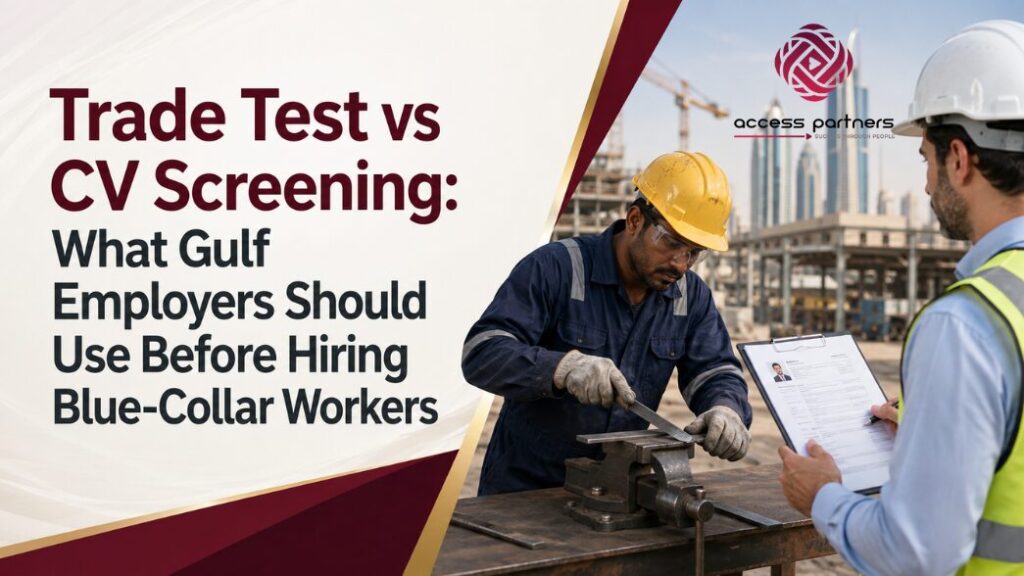
A trade test is a practical skill assessment. Instead of only reading about the worker’s experience, the employer or recruitment agency checks how the worker performs the actual job task.
For example:
- A welder may be asked to complete a weld joint.
- An electrician may be asked to read a wiring diagram or work on a panel.
- An HVAC technician may be asked to identify faults or explain maintenance steps.
- A plumber may be asked to demonstrate pipe fitting or repair work.
- A heavy driver may be checked for licence category, driving experience and role suitability.
- A machine or equipment operator may be assessed on safety awareness and operating knowledge.
This gives the employer a more realistic view of the worker’s ability.
The purpose of a trade test is not only to pass or fail a candidate. It helps confirm whether the candidate is suitable for the exact job, site condition and project requirement.
For Gulf employers, this is especially important because once a worker is selected, the recruitment process moves into documentation, medical clearance, visa processing, ticketing and mobilization. If the worker fails after arrival, the employer loses time at the most expensive stage of hiring.
CV Screening vs Trade Test: What Is the Difference?
| Hiring Step | What It Checks | What It Cannot Fully Prove |
| CV Screening | Experience, job history, previous roles, certificates and basic suitability | Actual hands-on skill, site readiness, safety habits and work quality |
| Trade Test | Practical ability, task performance, technical understanding and role readiness | Complete employment history or long-term attitude |
| Best Process | Use CV screening first, then trade testing for shortlisted candidates | Do not depend on only one method |
The best recruitment process uses both. CV screening helps identify who should be tested. Trade testing helps confirm who should be selected.
Where CV Screening Alone Falls Short
CV screening becomes risky when employers use it as the only decision-making tool.
This is common when hiring is urgent. A project deadline is close. A contractor needs workers quickly. A facility management company has a new contract starting. A logistics company needs drivers and warehouse workers immediately.
In that pressure, employers may approve candidates based only on the CV.
That can create problems such as:
- Workers who cannot perform the trade properly
- Candidates with weak practical knowledge
- Mismatch between experience claimed and skill delivered
- Poor safety awareness
- Slow productivity after joining
- Supervisor time wasted on correction and retraining
- Replacement hiring after mobilization
For office roles, a CV and interview may be enough to understand basic suitability. But for blue-collar roles, the work is physical, technical and site-based. The skill has to be seen, not only read.
Why Trade Testing Matters More in Gulf Manpower Hiring
Gulf employers often hire workers from India and other countries for large-scale projects in construction, oil and gas, facility management, logistics, hospitality, FMCG, retail and shipping.
In these industries, wrong hiring does not affect only one role. It can affect the entire workflow.
A weak electrician can delay maintenance work.
An untested welder can create quality issues.
A poor HVAC technician can increase repeat complaints.
An unfit driver can create operational and safety risks.
An untrained hospitality worker can affect guest experience.
This is why trade testing should be treated as a risk-control step, not an extra formality.
A few days spent on proper assessment before selection can save weeks of replacement hiring later.
The Real Cost of Skipping the Trade Test
The cost of a wrong blue-collar hire is not limited to the recruitment fee.
Employers may also lose money through:
- Site delays
- Rework
- Supervisor correction time
- Repeat recruitment
- Medical and documentation cost
- Replacement mobilization
- Productivity loss
- Client dissatisfaction
- Pressure on the existing team
In Gulf recruitment, the cost becomes higher because overseas hiring includes multiple steps after selection. Once the candidate moves into documentation, medical, visa and deployment, replacing him is not instant.
If the worker is not suitable after arrival, the employer has to restart part of the process. This can delay the project, contract or operation that the worker was hired to support.
That is why the safest hiring approach is simple:
Screen first. Test before final approval. Mobilize only after verification.
The Right Hiring Process for Blue-Collar Workers
Gulf employers should follow a structured process before approving candidates for deployment.
1. Start with a Clear Job Requirement
The employer should share the exact role, skill requirement, work location, salary range, duty hours, benefits, contract terms and deployment timeline.
A vague requirement leads to weak shortlisting. A clear requirement helps the agency find the right candidates faster.
2. Shortlist Through CV Screening
The recruitment team should review profiles based on relevant experience, trade background, past project exposure and basic eligibility.
At this stage, unsuitable candidates should be removed before the employer spends time on interviews or testing.
3. Conduct a Practical Trade Test
Shortlisted candidates should go through a practical assessment based on the role. The test should match the actual work the candidate is expected to perform.
For technical roles, the assessment should check skill, safety understanding, tools knowledge and task quality.
4. Verify Documents and Experience
After the candidate passes the skill check, the recruitment team should verify key documents, certificates, passport details and employment history wherever applicable.
This helps reduce the risk of fake experience claims or incomplete documentation.
5. Proceed With Medical, Visa and Mobilization
Only after the candidate is screened, tested and verified should the process move to medical clearance, visa processing, ticketing and deployment.
This order reduces the chance of spending time and money on the wrong candidate.
Which Blue-Collar Roles Need Trade Testing?
Trade testing is especially important for roles where poor skill can cause delay, rework, safety risk or quality failure.
Common roles include:
- Welders
- Pipe fitters
- Fabricators
- Electricians
- HVAC technicians
- AC technicians
- Plumbers
- MEP technicians
- Riggers
- Shuttering carpenters
- Steel fixers
- Heavy drivers
- Forklift operators
- Crane operators
- Equipment operators
- Maintenance technicians
- Industrial workers
- Kitchen and hospitality staff where practical skill is required
Not every role needs the same type of test. A welder may need a technical weld test. A driver may need a licence and driving suitability checks. A hospitality worker may need grooming, communication and service-readiness assessment.
The test should match the trade.
What Gulf Employers Should Ask Before Approving Candidates
Before approving a blue-collar candidate, employers should ask these questions:
- Has the CV been checked against the actual job requirement?
- Has the worker performed this trade before?
- Has the worker passed a practical skill test?
- Is the test relevant to the job site requirement?
- Are the documents complete and valid?
- Is the candidate medically and physically suitable for the role?
- Is the candidate ready for overseas deployment?
- Has the salary, benefits and contract expectation been clearly explained?
- Is the worker serious about joining?
These questions help employers avoid a common mistake: selecting candidates who look good on paper but are not ready for the job.
How Access Partners Helps Gulf Employers Hire Better Blue-Collar Workers
Access Partners is an overseas manpower consultancy founded in 2005, with a strong recruitment base in India and physical presence in Saudi Arabia.
We help Gulf employers hire skilled and semi-skilled manpower across:
- Construction
- Operation and maintenance
- Logistics
- Hospitality
- Oil and gas
- FMCG and retail
- Shipping
Our recruitment process is built to reduce wrong hiring and deployment risk. We do not depend only on CVs. We shortlist candidates based on employer requirements, check their background, arrange practical assessment where required, verify documents and support the complete mobilization process.
For employers in Saudi Arabia, UAE and the wider Gulf, this means a more reliable hiring pipeline.
You do not just receive profiles. You receive workers who are screened, assessed and prepared for deployment.
Final Answer: Use CV Screening and Trade Testing Together
CV screening and trade testing are not competing methods. They are two parts of the same hiring process.
CV screening helps employers shortlist quickly.
Trade testing helps employers select confidently.
For Gulf blue-collar recruitment, the safest process is to use the CV as the first filter and the trade test as the proof.
When employers skip the trade test, they increase the risk of wrong hiring, rework, delays and replacement costs. When they use both methods together, they make better hiring decisions before the worker reaches the site.
If your company is hiring blue-collar workers for Saudi Arabia, UAE or the wider Gulf, Access Partners can help you shortlist, assess, verify and mobilize the right candidates from India.
Need skilled manpower for your next project? Contact Access Partners to discuss your hiring requirement.
FAQs
Is CV screening enough for blue-collar hiring?
No. CV screening is useful for shortlisting, but it cannot fully prove practical skill. For skilled blue-collar roles, employers should use CV screening followed by a trade test before final approval.
What is a trade test in manpower recruitment?
A trade test is a practical skill assessment where the worker performs a task related to the job. It helps employers check whether the candidate can actually do the work required on site.
Which workers should be trade tested before Gulf deployment?
Trade testing is important for welders, electricians, HVAC technicians, plumbers, pipe fitters, riggers, steel fixers, shuttering carpenters, machine operators, heavy drivers and other skilled blue-collar roles.
Does a trade test delay the hiring process?
A well-planned trade test may add a short assessment step, but it can save far more time by reducing wrong hiring, rework and replacement recruitment after deployment.
Why do Gulf employers need trade testing for workers from India?
Gulf employers often hire workers for project-based, technical and site-critical roles. Trade testing helps confirm that the candidate has the right skill, safety awareness and job readiness before mobilization.
Does Access Partners manage trade testing and screening?
Yes. Access Partners supports Gulf employers with CV screening, candidate shortlisting, trade assessment coordination, documentation and mobilization support for skilled and semi-skilled workers from India.
Which countries does Access Partners recruit for?
Access Partners primarily supports employers in Saudi Arabia and UAE, along with wider Gulf hiring requirements across industries such as construction, O&M, logistics, hospitality, oil and gas, FMCG, retail and shipping.