Quick Answer: To screen hospitality candidates the right way, test their spoken language skills in a live conversation, check their grooming and presentation against your brand’s standards, and run them through a short service simulation before you make an offer. Most hotels that struggle with early exits skipped one of these three checks. A recruitment partner who does this screening in India, before candidates ever board a flight, saves you the cost of a mis-hire.
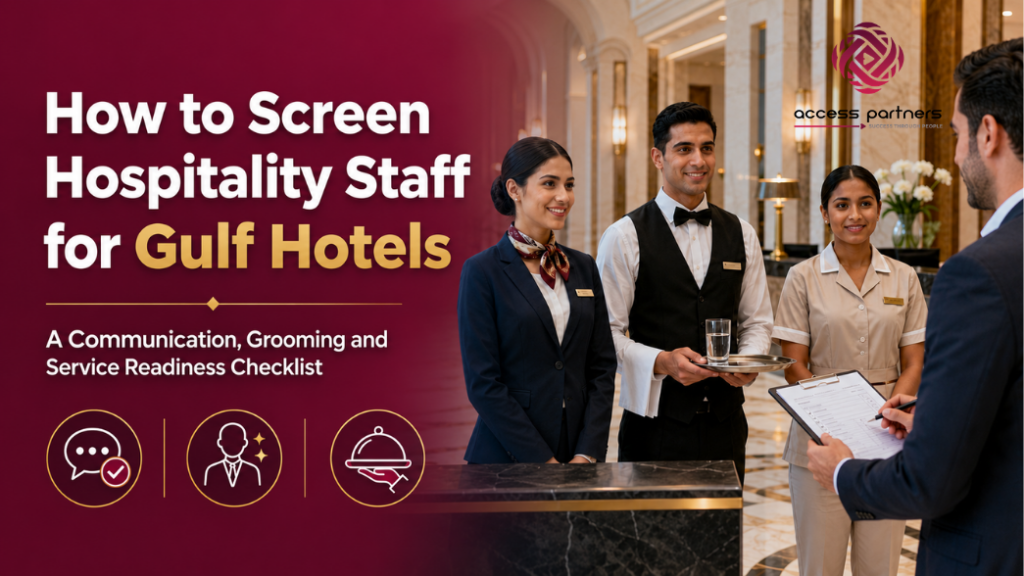
Why a Bad Hospitality Hire Costs More Than You Think
You hire a front office agent or a housekeeping supervisor. Training starts. Guests start noticing them. Then, within a few months, they leave — or you have to let them go because they can’t hold a guest conversation or don’t meet grooming standards. You start the hiring process again.
This is not a rare story. Across the GCC, staff turnover rose from 8% in 2024 to 13% in 2025, and tourism and hospitality led every sector at 15.9% turnover. Hiring itself has also gotten more crowded — the average number of applicants per open role jumped over 80% in 2025 to around 321 candidates per vacancy. More applications does not mean better hires. It means more resumes that look right on paper but were never actually tested.
Saudi Arabia’s tourism and hospitality sector alone employed over a million people by Q3 2025, with foreign workers making up about 76% of that workforce. As Vision 2030 projects keep adding hotel rooms and resorts, the employers who screen candidates properly, before they land, are the ones who avoid repeat hiring cycles.
Step 1: Test Communication, Don’t Just Ask About It
A CV can say “fluent in English.” That tells you nothing about how someone handles a guest complaint at 11pm. Real screening means:
- A live phone or video call, not a written test, so you hear how they actually speak
- A role-play scenario — a late checkout request, a room service delay, a language mix-up with a guest
- Listening for tone and patience, not just grammar. Guests remember how they were made to feel, not whether a sentence was perfect
- Checking comfort with the second language your property needs, whether that’s Arabic basics, Hindi, Tagalog, or French
Step 2: Check Grooming and Presentation Against Your Brand
Gulf hotels hold strict standards here, and for good reason —presentable appearance and grooming are things hotels are strict about, and it’s often the first thing a guest notices. Before you hire:
- Ask for a recent, unfiltered photo, not a studio headshot
- Confirm the candidate understands uniform, hygiene, and appearance rules ahead of time, not after arrival
- Watch how they carry themselves in a video call — posture and eye contact often say more than the resume
- Flag any gap between what the candidate expects and what your property actually requires, so there are no surprises on day one
Step 3: Run a Service Readiness Simulation
This is the step most employers skip, and it’s the one that predicts performance best. A short simulation — checking in a guest, resolving a mock complaint, setting a table — shows you how someone thinks on their feet. A trade test does this better than any interview question, because it shows real behaviour instead of a rehearsed answer.
Why More Gulf Employers Are Letting a Recruitment Partner Handle This
Screening every candidate yourself, from another country, is hard to do well. You’re managing time zones, video calls, document checks, and Saudization or Emiratization quota rules all at once — and quota categories keep tightening, especially in hospitality and retail roles. Most Gulf HR teams don’t have the bandwidth to run three-stage screening on every applicant while also running the property.
This is exactly the gap a manpower recruitment consultancy is built to close.
How Access Partners Screens Hospitality Talent Before You Ever See a Resume
Access Partners has been sourcing manpower for Gulf employers for close to two decades, with offices in Mumbai, Saudi Arabia, and the UAE. We don’t forward resumes — every hospitality candidate goes through a structured process before you see their profile: a live communication interview, a grooming and presentation check against your property’s standards, and a hands-on trade test suited to the role, whether that’s front office, housekeeping, F&B, or guest services.
Because we source across India and manage compliance and mobilization from our Gulf offices directly, you get candidates who are pre-tested, not just pre-listed. That’s the difference between hiring once and hiring on repeat.
If you’re building or scaling a hospitality team in Saudi Arabia, UAE, or anywhere in the Gulf, talk to Access Partners about your staffing plan. Contact Access Partners today to discuss your hospitality hiring needs.
Frequently Asked Questions
How do I hire hospitality staff from India for my Gulf hotel?
Work with a licensed Indian recruitment agency that sources, screens, and manages the visa and mobilization process. This is faster and safer than hiring directly, since the agency handles compliance on both sides.
What is a trade test in hospitality recruitment?
A trade test is a short, hands-on task — like handling a mock check-in or setting a table — used to confirm a candidate can actually do the job, not just describe it.
How long does it take to hire hospitality staff from India for the Gulf?
With a recruitment partner already sourcing and screening candidates, most roles can be filled within a few weeks, compared to months when hiring directly.
Why use a recruitment agency instead of hiring directly?
An agency screens communication, grooming, and service readiness before you interview anyone, and manages visa, quota, and compliance requirements you’d otherwise handle alone.