Quick Answer: Gulf employers hire heavy equipment operators from India by checking three things first. Look for a valid operating license or certificate for the exact machine type. Require a hands-on practical trade test on that machine. Confirm GAMCA medical clearance. Do this through a licensed Recruiting Agent, not an informal contact. Only a licensed agency can legally process eMigrate and visa steps. A poorly checked operator can damage machinery or stall a site. This checklist matters more than it looks.
One wrong operator on a crane or excavator does not just slow down a project. It can damage a machine worth lakhs. It can injure someone on site. It can bring an inspection that halts work for days. Hiring a heavy equipment operator is not like hiring a general helper. The stakes are higher. So is the cost of getting it wrong. This guide walks through exactly what to check. Read it before you bring an operator onto your Gulf site.
Why Demand for Operators Is Rising
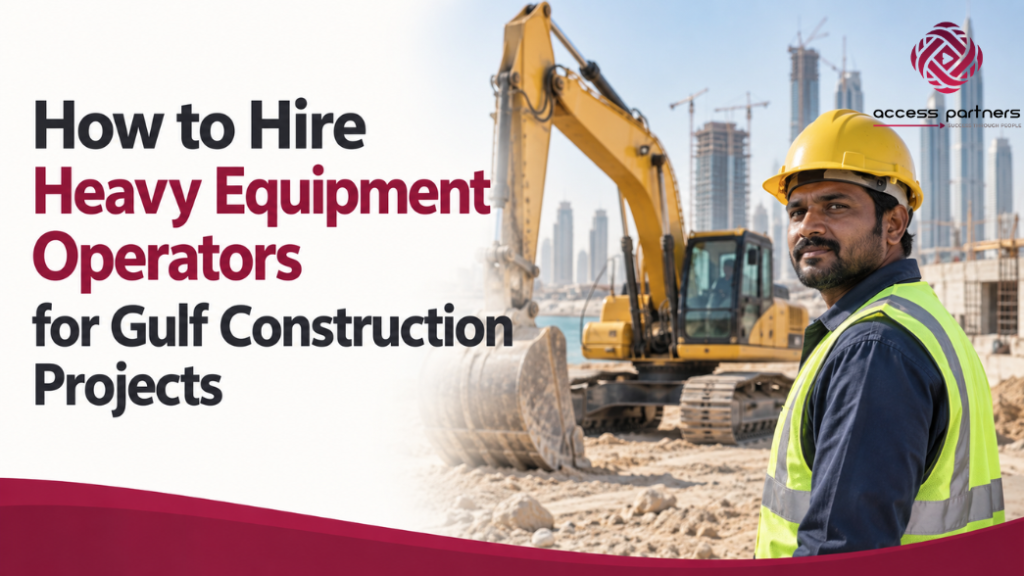
Gulf construction is not slowing down. Saudi Arabia and the UAE keep pouring money into megaprojects. Smart cities and infrastructure builds need heavy machinery every single day (My Equipment, Gulf Construction Equipment Market 2026 report). But the machines are not the hard part to find. Skilled people who can run them safely are. Industry reporting on the Gulf equipment market points to a real bottleneck. It calls this “a lack of competent equipment operators.” This happens even as more machines arrive on site every year. Crane operators are the most in-demand role in this space. They are also the highest paid. Excavator, bulldozer, and loader operators come next in demand (AYK Global, GCC Jobs for Heavy Equipment Operators, 2026). This gap is exactly why employers now look to India. India has long supplied trained operators to Gulf sites.
The Roles Employers Are Hiring For
Not all equipment operator roles are the same. Employers should be specific about which one they need. The main categories are crane operators, excavator operators, bulldozer operators, loader operators, and forklift operators. Crane operators run mobile or crawler cranes. Forklift operators handle site logistics. Each machine type needs its own experience. Each also needs its own certification. A skilled crane operator is not automatically qualified to run an excavator. Treating these roles as interchangeable is one of the most common hiring mistakes employers make. It is also one of the easiest mistakes to avoid, once you know to ask the right question upfront.
The Certification Checklist Before You Hire
Before approving any operator, check these four things.
First, ask for a valid operating license or certificate for the specific machine type. For crane and lifting work, look for training aligned with LEEA standards. LEEA is an internationally recognized lifting equipment body. It is used widely across Gulf sites (TUV-ISOCERT Saudi Arabia, Lifting Equipment Operator Certification Requirements). A generic “heavy machinery” certificate is not the same as a crane-specific one. Do not accept one in place of the other.
Second, insist on a hands-on practical trade test. A paper certificate alone is not enough. Certification proves training happened in the past. A practical test proves the operator can run that exact machine safely today.
Third, confirm GAMCA medical clearance. Machine operation demands good vision, quick reflexes, and physical fitness. Gulf work visas require this check regardless of role, so build it into your timeline early.
Fourth, know what is and is not covered by Saudi Arabia’s Skill Verification Program, or SVP. SVP currently verifies trades like electricians, plumbers, HVAC technicians, masons, and welders. It also covers heavy equipment technicians who repair machines (Access Partners, SVP Test Saudi 2025 Guide). But heavy equipment operators, the people who drive and run the machines, are not currently a named SVP trade category. This is a detail many employers get wrong. It does not mean operators skip verification altogether. It means their verification comes through the operating license and trade test above. It does not come through an SVP exam built for a different kind of trade.
How the Hiring Process Actually Works From India
Good hiring follows a clear order. Start with a Recruiting Agent holding a valid MEA/RA license. Only a licensed agency can legally source and deploy workers for overseas jobs. The agency should shortlist candidates by exact machine type, not general experience. Next comes the practical trade test on that machine. GAMCA medical checks follow right after. eMigrate processing runs for workers with an ECR passport. Visa paperwork moves alongside this, specific to the employer’s country and role category. The final step is mobilization. Time it so the operator arrives ready to work on day one, not mid-training.
Questions to Ask Before You Approve an Operator
A few direct questions can save a project real money. Does this operator have a license for this exact machine, not just “heavy equipment” in general? Has someone actually watched them operate it, or was the decision based only on a resume? How many years of experience do they have on this specific model or class of machine? Is their medical clearance current, not from a past job years ago? Can the agency show you proof of the practical trade test, not just describe it? If an agency cannot answer these clearly, that is a warning sign worth taking seriously.
Why Employers Choose Access Partners
Access Partners has sourced skilled and semi-skilled workers for Gulf employers since 2005. We hold a valid MEA/RA license as an overseas manpower consultancy. For heavy equipment roles, we match candidates by exact machine type. We verify licenses and hands-on ability before anyone reaches your shortlist, not after. We manage GAMCA, eMigrate, and visa processing end to end. We are also clear about which trades fall under SVP. We explain which trades need a different kind of check, like operator licensing and practical testing. We have offices in both India and Saudi Arabia. This lets us resolve a documentation question or a certification gap quickly. We do not lose days to distance. Our goal is simple. We want an operator who can run your machine safely from the first shift, not one who needs to learn on your site.
If your project needs certified equipment operators, talk to Access Partners about your requirement today. For other in-demand construction trades, see our guides to civil, MEP, and finishing worker recruitment and hiring welders and pipe fitters for Gulf oil & gas projects.
Keywords Used in This Article
Primary: hire heavy equipment operators Gulf, heavy equipment operators from India, crane operator recruitment Saudi Arabia, excavator operator hiring UAE, construction equipment operator recruitment agency
Secondary / supporting: LEEA crane operator certification, GAMCA medical clearance, MEA RA licensed recruitment agency, Saudi Skill Verification Program (SVP), overseas manpower consultancy India, heavy equipment operator license Gulf, bulldozer loader operator jobs Gulf
Meta Title: How to Hire Heavy Equipment Operators for Gulf Construction Projects Meta Description: A practical checklist for hiring certified crane, excavator, and loader operators from India for Gulf construction sites, safely and without delays. Suggested URL slug: /hire-heavy-equipment-operators-gulf-construction-projects/