Quick Answer: The safest way to avoid fake experience claims is to skip paper certificates alone. Ask for a trade test. Call the worker’s past employer directly. And work only with a licensed agency that verifies skills before sending you a single profile.
You checked the certificate. You checked the resume. The worker looked perfect on paper.
Three weeks into the project, you find out he can’t read a basic drawing. Or he’s never actually run the machine he claimed to operate for five years.
Now you’re paying for a return flight. Restarting the hiring process. Explaining the delay to your client.
This happens more often than most Gulf employers expect. Fake experience letters and inflated skill claims are one of the most common — and costly — risks in blue-collar hiring from India. The good news is, you can catch this before you sign anything.
Why Fake Experience Claims Are So Common
Every year, millions of Indian workers apply for jobs in the Gulf. Some go through licensed channels. Many don’t.
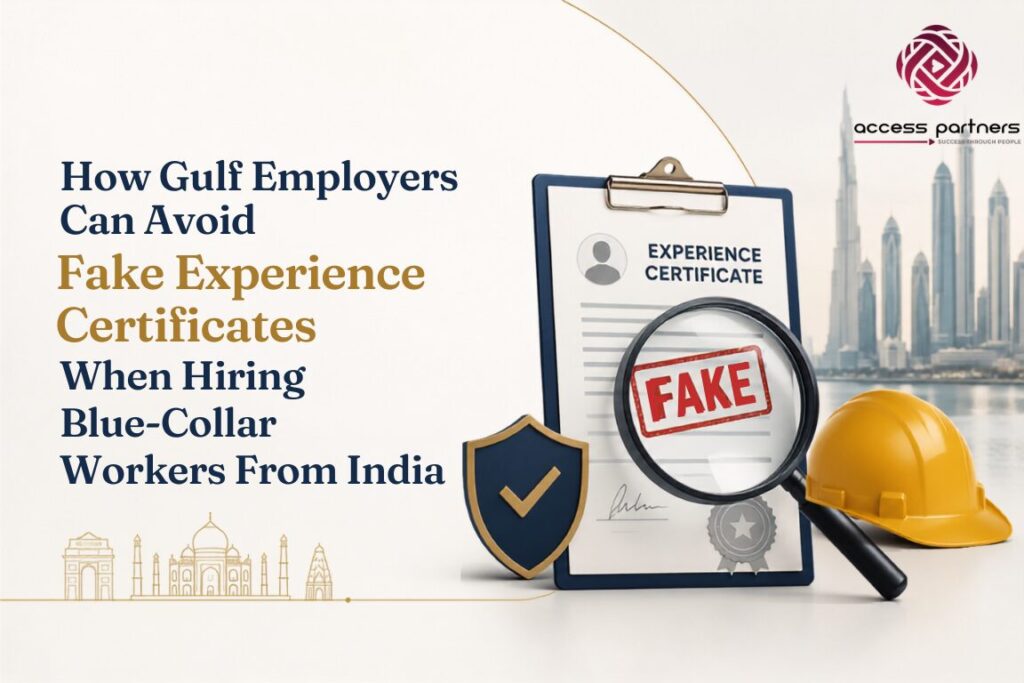
India’s Ministry of External Affairs has repeatedly warned that unregistered agents operate without any government license, and some workers pay these agents heavily for fake job offers, forged contracts, and inflated experience letters. In one large case uncovered in late 2025, investigators in India seized over 100,000 forged certificates from a single racket, a reminder of how widespread document fraud has become.
A certificate is easy to print. Real skill is not. That gap is exactly where employers get burned.
What a Bad Hire Really Costs You
A weak or fake hire isn’t just an inconvenience. It hits your project directly:
- Lost time. Replacing a worker mid-project can delay timelines by weeks.
- Extra cost. Flights, visa fees, and medical costs get repeated for the replacement.
- Safety risk. An unqualified worker on a construction or oil & gas site is a real hazard, not just a paperwork problem.
- Client trust. Delays and mistakes reflect on you, not just the worker.
With GCC construction demand still growing strongly — the region’s construction sector is projected to keep expanding through 2033 as megaprojects continue — skilled labor is already the tightest resource on most sites. You don’t have room to lose weeks on a bad hire.
5 Ways to Check If a Worker’s Experience Is Real
1. Ask for a trade test, not just a certificate. A welder should weld. An electrician should wire a panel. A real skill shows up in five minutes on a test bench. A fake one doesn’t.
2. Call the worker’s last two employers yourself. Don’t rely on a written reference letter. A short phone call to the actual site supervisor tells you more than any document.
3. Check documents through official channels. In Saudi Arabia, contracts are verified through Musaned. In the UAE, they’re registered with MOHRE. If an agent avoids these official systems, that’s a warning sign, not a shortcut.
4. Run a short video interview with real job questions. Ask the worker to explain a task step by step. Someone who has actually done the job can describe it in plain, specific detail. Someone who hasn’t will speak in generalities.
5. Work only with an MEA-licensed agency that pre-screens candidates. This is the step that removes the guesswork from the first four. A licensed agency should already be doing this work before a profile ever reaches your desk.
How Access Partners Verifies Every Worker Before You See Their Profile
Access Partners is a Ministry of External Affairs (MEA) licensed recruitment consultancy, sourcing skilled and semi-skilled workers across Construction, Oil & Gas, Operation & Maintenance, FMCG, Hospitality, and Logistics.
Every worker we shortlist goes through trade-specific testing, document verification, and a direct background check with past employers — before their profile ever reaches you. We don’t just collect paperwork. We confirm the skill behind it.
We also run a dual-office structure: sourcing candidates from India, with a client-facing presence in Saudi Arabia. That means you’re not dealing with a distant agency that disappears after placement. We’re on the ground for follow-up, replacements, and compliance questions, on both sides of the hiring process.
If you’ve been burned by a fake certificate before, this is the difference a licensed, verification-first partner makes.
Frequently Asked Questions
How can I verify a blue-collar worker’s experience before hiring from India? Combine a practical trade test, a direct call to their previous employer, and document verification through official government portals. Never rely on a certificate alone.
What documents actually prove real skill in construction or oil & gas workers? Trade-specific certifications (like CSWIP for welders or CPCS for crane operators), safety training records (NEBOSH, IOSH), and a verifiable work history from named past employers.
Is it safe to hire blue-collar workers from India for Gulf projects? Yes, when you work through an MEA-licensed agency that runs proper verification. The risk isn’t hiring from India — it’s hiring through unlicensed, unverified channels.
Ready to Hire Workers You Can Trust?
Fake experience claims cost you time, money, and safety on site. You don’t have to gamble on a certificate. Access Partners verifies every candidate before you ever see their name.
Get in touch with Access Partners today for pre-verified, skill-tested workers for your Gulf project.