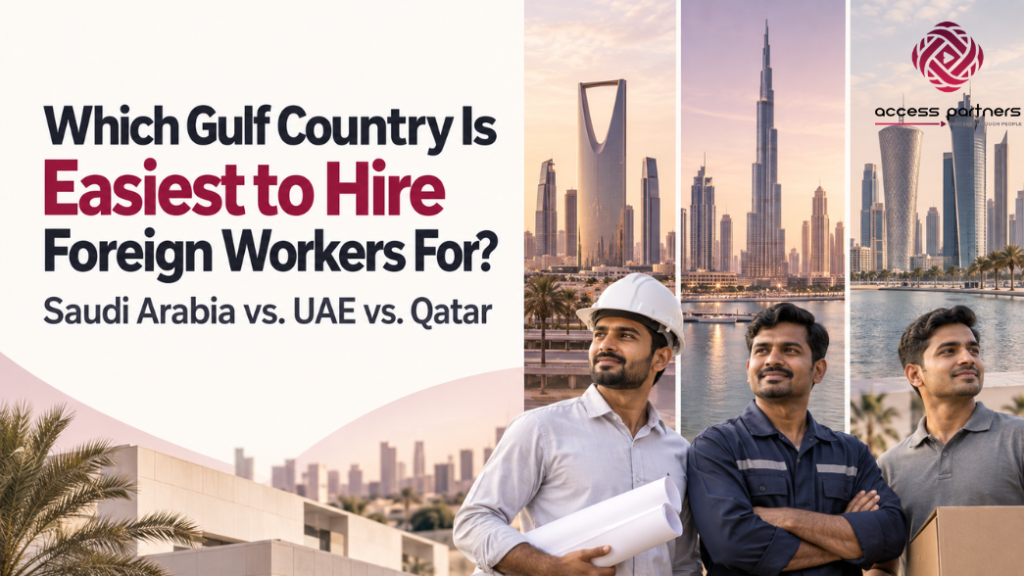
Quick Answer: Qatar is currently the fastest and cheapest Gulf country to sponsor foreign workers in. Visas are often ready in 7 to 14 days. Government fees are lower than in its neighbors too. The UAE is close behind on speed. But it is tightening fast due to Emiratisation quotas. Saudi Arabia takes the longest and costs the most in recurring fees. Even so, it remains the largest single market for workers from India by far. The easiest country really depends on your company size, your industry, and how many workers you plan to hire.
Every Gulf country asks a foreign employer to do the same basic thing. Sponsor a worker, and let them stay and work legally. But the paperwork behind that one sentence looks very different in Riyadh, Dubai, and Doha. An employer who assumes the process is the same everywhere can end up with a hiring timeline that is weeks off. Here is how the three countries actually compare. We will also look at what this means if you are hiring from India.
What Each Country Actually Requires
Saudi Arabia runs on a system called Nitaqat. It sorts companies into colored bands. The band depends on how many Saudi nationals a company employs for its size and sector. A company in the Red band cannot issue or renew any foreign worker visas at all. This system got stricter in 2026. The old Yellow band merged into Red as of April 16, 2026 (Topsource Worldwide, GCC Work Visas Compared, 2026). That closed a middle-ground option many employers used to rely on. Saudi Arabia also charges a monthly expat levy. This applies per worker and per dependent. Over a long project, this cost adds up fast.
The UAE runs on a different rule, called Emiratisation. Firms with 50 or more skilled staff must reach 9% Emirati employment by mid-2026. This rule now reaches smaller companies too, down to just 20 employees. Missing the target is not just a fine. It can freeze a company’s MOHRE portal. That blocks every new work permit until the company fixes its ratio.
Qatar has moved the furthest from the old kafala model. It dropped the No-Objection Certificate requirement back in 2020. It also dropped exit permits that year. Workers gained more freedom to change jobs and travel. Qatar’s own localization rule is called Qatarisation. It became legally enforceable under Law No. 12 of 2024. But it targets specific sectors hardest. Banking, insurance, energy, and government roles feel it most. Most blue-collar and technical hiring sees much less friction than in the other two countries.
So Which One Is Actually Easiest?
There is no single winner for every employer. It depends on what you need most. If speed and low cost matter most, Qatar usually wins. This is especially true outside its regulated sectors. If your company is smaller, and not yet caught by strict quota rules, the UAE offers a fast, well-documented process. That window is closing, though, as Emiratisation keeps expanding. If you need the largest possible pool of workers, the answer changes again. Saudi Arabia is still where the deepest demand sits. It is also where the deepest talent pipeline from India already exists. This holds true even though its process takes longer. It also costs more to maintain over time.
What This Means If You’re Hiring From India
Here is the part that does not change, no matter which Gulf country you choose. Every worker leaving India still needs the same core steps on the India side. This includes a licensed Recruiting Agent with a valid MEA/RA license. It also includes a real trade test, not just a CV review. GAMCA medical clearance comes next. So does eMigrate processing for workers with an ECR passport. What changes is everything that happens after the worker’s paperwork reaches the Gulf country’s own system. This is exactly where an employer needs a partner who understands both sides. Knowing only one side is not enough.
A Quick Way to Compare Your Options
Before you commit to one country, ask a few direct questions. How many workers do you need, and how fast? A large, long-term project usually points toward Saudi Arabia despite the slower process. A smaller, faster hire may fit the UAE or Qatar better. Does your industry fall inside a strict quota zone, like UAE Emiratisation or Qatar’s banking and energy rules? If yes, budget extra time for compliance checks. Finally, ask what happens if plans change mid-project. Switching countries mid-hire is far harder than planning the right one from the start.
Why Employers Work With Access Partners
Access Partners has sourced skilled and semi-skilled workers for Gulf employers since 2005. We hold a valid MEA/RA license as an overseas manpower consultancy. We maintain a dedicated office in Saudi Arabia. This means we handle Nitaqat-aware hiring plans and levy timelines with direct, on-the-ground knowledge, not guesswork from a distance. For employers hiring into the UAE or Qatar, we prepare workers to the same trade-tested, document-complete standard on the India side. That way, the only variables left are the ones specific to that country’s own process. Wherever your project sits in the Gulf, our job stays the same. We make sure the worker who leaves India is the worker who is actually ready to start.
Rules in all three countries keep shifting year to year, so what was true last year may not hold today. A partner who tracks these changes daily is worth more than a one-time guide. If you are weighing where to hire next, talk to Access Partners about which Gulf market fits your project best.