A stalled site costs money every single hour. But a site running without enough safety officers can cost lives — and now it can cost you the project too. Saudi Arabia’s Ministerial Decision 3337 makes this simple: no qualified safety officer on site, no green light to work. If you’re mobilizing a team in Riyadh, Jubail, or NEOM this year, that one rule can decide how fast — or how slow — your project starts.

Why Saudi Projects Need More Safety Officers Than Ever
Saudi Arabia’s construction pipeline is enormous right now, with projects worth trillions of riyals planned over the coming years. Giga-projects like NEOM, Red Sea Global, Qiddiya, and Diriyah Gate are hiring workers by the tens of thousands. NEOM alone is expected to employ over a million workers at peak construction — and every one of those workers needs safety coverage.
That’s exactly why Ministerial Decision 3337 exists. It sets a clear ratio: one qualified safety officer for every 50 to 300 workers on high-risk sites such as construction, oil and gas, and manufacturing. Sites with more than 300 workers need a dedicated HSE manager. On NEOM and similar giga-projects, contractors often require one HSE officer per 25 workers during the busiest phases.
There’s also a strict summer rule worth knowing. Outdoor work is banned between 12 noon and 3 pm through June, July, and August. Good HSE officers plan shift schedules around this every year, since missing it can mean fines or a stopped site.
What Certifications Should You Look For?
Not every safety officer candidate is equal, and checking paper qualifications matters more than reading a CV summary. The two certifications Saudi employers ask for most are:
- NEBOSH IGC (International General Certificate) — the baseline qualification for mid-level and senior HSE roles, and a requirement on most Aramco and SABIC contractor sites.
- OSHA 30-Hour (Construction) — widely accepted for entry to mid-level construction safety roles, especially on NEOM contracts.
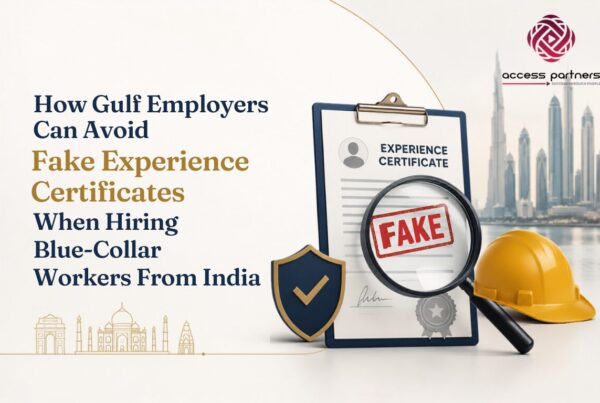
One caution: certificates can be faked or expired. Any recruitment partner you work with should verify certification numbers directly with the awarding body before submitting a candidate — not just accept a scanned copy at face value.
Why Indian HSE Officers Are in High Demand Across the Gulf
India trains a large number of NEBOSH and OSHA-certified safety professionals every year, many already experienced on Gulf construction and oil & gas sites. This gives Saudi employers a few real advantages:
- Strong English proficiency for toolbox talks, incident reports, and coordination with international contractors.
- Familiarity with Gulf project culture, since a large share of Indian HSE officers have already worked in the UAE, Qatar, or Saudi Arabia.
- Competitive salary expectations compared to Western-origin HSE hires, without giving up certification quality.
- Established recruitment pipelines, built on decades of India-to-GCC skilled manpower supply.
What the Hiring Process Should Look Like
Hiring an HSE officer from India isn’t just about finding a CV that matches the job description. A proper process includes:
- Sourcing candidates with verified NEBOSH/OSHA credentials and relevant site experience.
- Screening and interviews, including a technical safety interview — not HR screening alone.
- Certification verification directly with the awarding body.
- GAMCA medical clearance, required for Gulf-bound workers from GAMCA-member countries.
- eMigrate registration and ECR/ECNR compliance, since Indian nationals travelling for work need Emigration Clearance depending on passport category.
- Visa processing and mobilization, timed against your project’s real start date — not the date the offer letter was signed.
Skipping any one of these steps is how employers end up with a safety officer stuck at the airport, or worse, one who doesn’t actually hold the certification claimed on paper.
Common Mistakes Gulf Employers Make
Employers experienced in blue-collar recruitment sometimes underestimate HSE hiring, since it can look more “office-based” than trade hiring. Three mistakes we see often:
- Accepting a NEBOSH certificate copy without verifying it against the awarding body’s own record.
- Not aligning the safety officer’s start date with the project’s actual mobilization date, wasting weeks of unused labour cost.
- Hiring one safety officer for a large site instead of following the legally required 1:50 to 1:300 ratio.
How Access Partners Helps Gulf Employers Get This Right
Access Partners has sourced skilled and safety manpower for Gulf oil & gas, construction, and facilities management employers since 2005, with a sourcing base in India and a client-facing office in Saudi Arabia. Every HSE officer we put forward goes through certification verification, technical screening, and full eMigrate/GAMCA compliance before mobilization — so what lands on your site matches what was promised on paper.
If you’re mobilizing a project team in Saudi Arabia and need HSE officers, safety supervisors, or full site safety teams, reach out to Access Partners. We handle the sourcing, verification, and compliance — you focus on the build.